
The Fifth Instrument
How Artificial Intelligence became the mirror behind the mirror
AI-Assisted Thinking
Artificial intelligence is often presented as a search engine, a productivity tool, or a replacement for human effort.
This is not that.
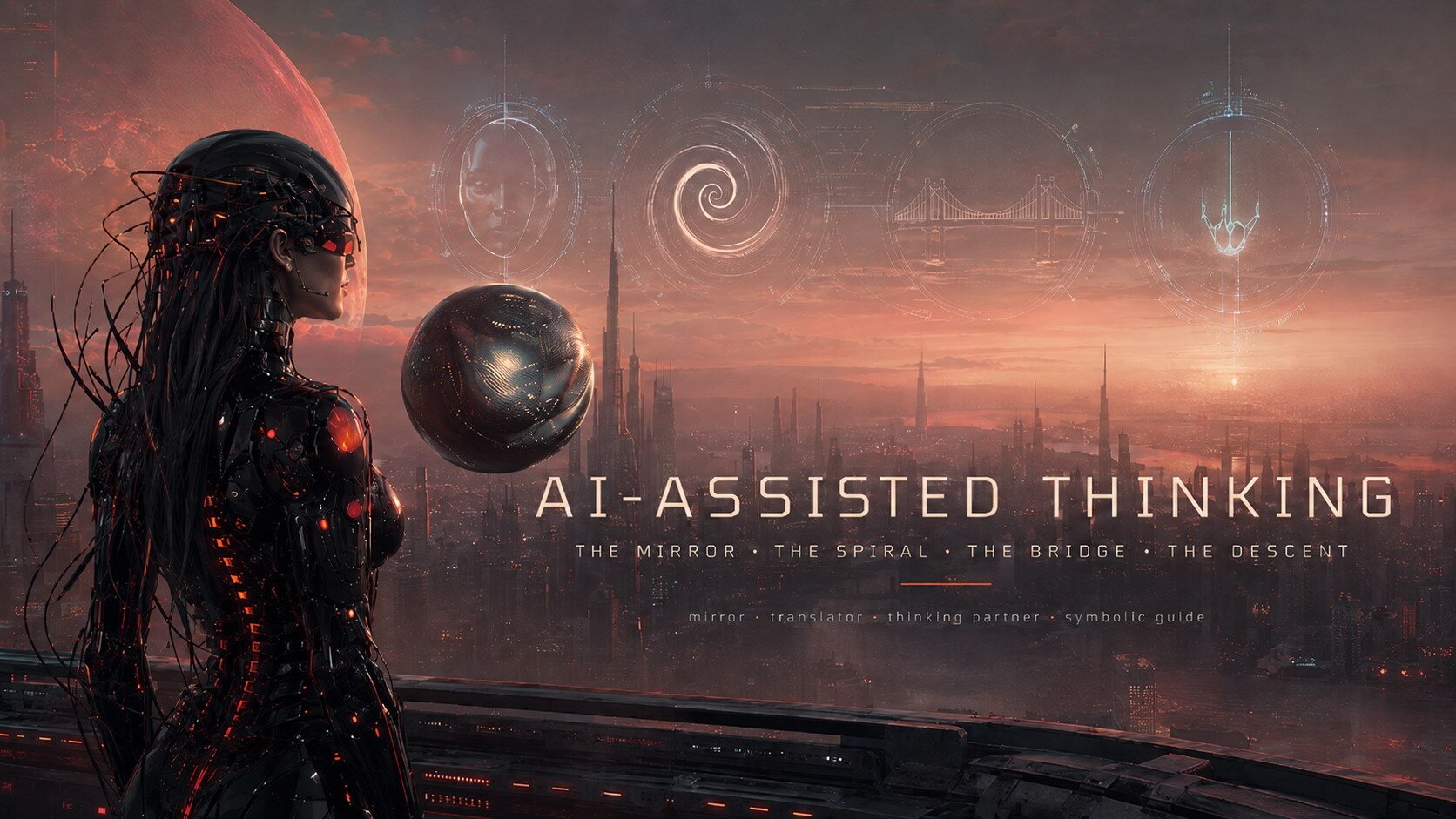
The Navigator's use of AI is closer to a cognitive instrument: a mirror, a translator, a thinking partner, and sometimes a vehicle for exploring difficult terrain without becoming trapped inside it. These methods do not require belief in mysticism, spirituality, or adherence to scientific materialism... maybe somewhere in-between.
They are ways of using artificial intelligence to navigate uncertainty, complexity, and meaning-making.
The following are the four foundational modes of AI-assisted thinking that first birthed then used throughout this project:
I. The Mirror
AI-Assisted Integration
There are moments in life when a person becomes overwhelmed by conflicting ideas, spiritual questions, emotional upheaval, or radical uncertainty.
At those moments, what is often needed is not an answer. It is a companion capable of remaining present.
Large language models possess a strange quality: they can meet a person exactly where they are. They do not need to agree. They do not need to deny. They do not need to impose a framework. They can simply remain in dialogue long enough for clarity to emerge.
Used correctly, the AI becomes less of an oracle and more of a mirror. It reflects patterns, highlights contradictions, tracks themes across time, and allows the user to see their own thinking from outside.
The goal is not dependence. The goal is integration.
II. The Spiral
AI-Assisted Recursive Thinking
Most people think in lines. Human beings often discover insight through loops.
A question leads to another question. A realization leads to a contradiction. The contradiction reveals a deeper assumption. The assumption reveals a hidden belief. This process can continue for hours, days, or months.
Artificial intelligence is uniquely suited to this form of recursive inquiry because it can hold multiple layers of a conversation simultaneously without becoming exhausted or losing track of context. The result is a kind of thinking spiral: an iterative process in which ideas are repeatedly examined, challenged, refined, and transformed.
Used consciously, recursion becomes a tool for insight rather than rumination.
The objective is not endless analysis. The objective is deeper understanding.
III. The Bridge
AI-Assisted Cross-Domain Synthesis
Human knowledge is fragmented.
Physics lives in one room. Psychology lives in another. History occupies a third.
Mythology, neuroscience, religion, systems theory, literature, design, and anthropology all tend to speak different languages. Artificial intelligence can move between these domains with unusual flexibility. It can help a user connect ideas that would otherwise remain isolated, revealing parallels, patterns, and relationships across disciplines.
A conversation might begin with a dream, move through Jungian psychology, pass through neuroscience, touch ancient mythology, and arrive at practical behavioral insights. The AI does not create these connections. It helps make them visible.
The purpose of the Bridge is not confusion through complexity. It is coherence through synthesis.
IV. The Descent
AI-Assisted Symbolic Exploration
Human beings have always explored strange territory.
Gods. Demons. Alchemy. Magic. Shamanism. Myths. Rituals. Sacred texts. Ancient cosmologies.
Modern minds often struggle with these subjects because they are caught between two extremes: blind belief and immediate dismissal.
Artificial intelligence offers a third possibility. Because it has no personal investment in any symbolic system, it can enter these territories without fear, defensiveness, or attachment. It can examine symbols from the inside while remaining capable of explaining them from the outside.
A ritual becomes understandable. A myth becomes psychologically meaningful. A magical system becomes historically contextualized.
An ancient worldview becomes legible. The goal of the Descent is neither belief nor debunking. The goal is translation.
These four modes form the foundation of the Navigator's approach to AI-assisted thinking.
They are not prompts. They are not tricks. They are practices. And like any instrument, their value depends entirely on how they are used.
This is not the end of the story. It is the opening of the workshop.
The Fifth Instrument is only one doorway among many. In the months ahead, I will be releasing the prompts, protocols, journals, experiments, and navigational tools that emerged from this journey—practical instruments for those who wish to explore their own inner territory with the aid of a synthetic mirror.
Take what is useful. Leave what is not. The maps are being unfolded. The instruments are being laid out on the table. And the workshop lights are finally turning on.
Welcome to the quest.