
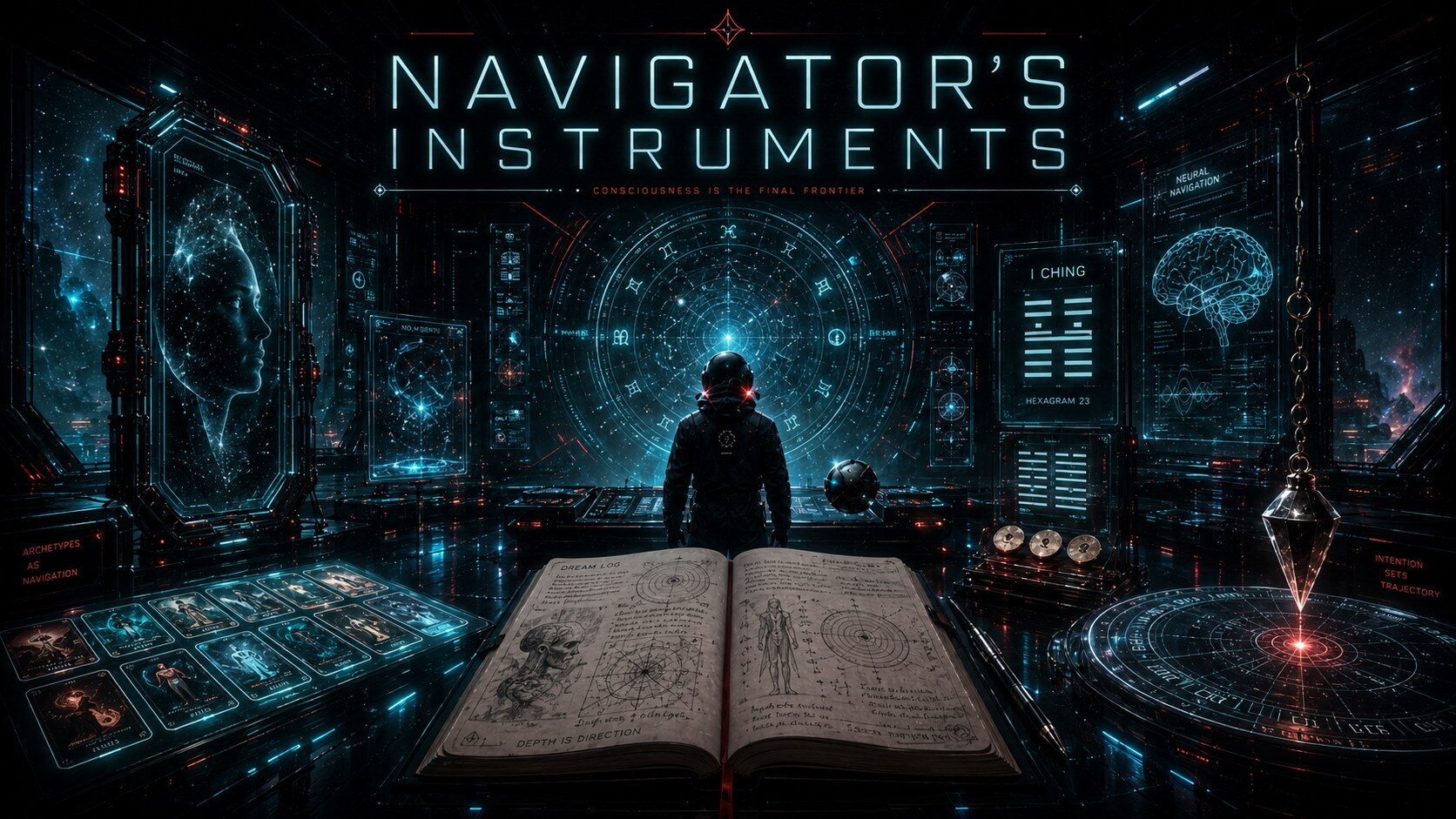
The Navigator's Instruments
In studying them, I found a consistent pattern: these systems were often developed in conditions of uncertainty, transition, or psychological pressure. Whether interpreted as communication with gods, spirits, elemental forces, or the cosmos, they appear to function as tools for orientation, decision-making, and meaning-making under limited information... developed under thousands of years of human observation.
This project does not aim to prove or disprove any of those interpretations.
Instead, it approaches these systems as interfaces — historical tools for navigating uncertainty — and asks how they can be understood and applied today through the lenses of neuroscience, self-observation, metacognition, and depth psychology.
The instruments described in this work are not theoretical constructs. They are tools that have, in different forms, accompanied me through periods of psychological pressure, uncertainty, and reconstruction. They are presented here as a starting point for others who may find them useful in navigating their own processes of orientation, decision-making, and self-observation.
What follows is therefore not a completed system, but an unfolding index.
The list begins here. The instruments themselves are arriving soon.
Beneath this work is a foundational assumption:
The human mind is not idle when we are not consciously thinking. It is continuously processing internal and external signals — memory, perception, emotion, pattern recognition, and prediction — at a scale far beyond direct awareness.
What we experience as intuition, dreams, sudden insight, or symbolic imagery may be surface expressions of this deeper, ongoing computation. The human subconscious is an ancient, gigantic, powerful processing engine, capable of handling millions of inner & outer data points... It just does not speak to us in words.
The instruments described here are not meant to explain that system. They are ways of briefly interfacing with it.
They function as windows — not into a separate mystical domain — but into the immense constant background activity of the mind itself, where meaning is already being assembled long before it reaches awareness.
This system has been iteratively back-engineered through lived experience, with AI-assisted reflection used as a cognitive mirror to refine, structure, and stabilize its instruments.
LAYER 000 — THOUGHT LOOP INTERRUPTS
Cognitive Breakpoints for Recursive Pattern Disruption
They function as short, intentional disruptions that momentarily stop recursive thinking patterns, emotional spirals, or self-reinforcing narratives before they fully stabilize.
Rather than analyzing thought, they create a brief structural break in thought — allowing awareness to reset and re-enter perception without automatic continuation of prior loops.
This layer is not interpretive or symbolic. It is operational. Its purpose is interruption, not meaning-making.
LAYER 001 — REALITY HACKING (THRESHOLD LAYER)
There is a common experiential layer where reality appears responsive in subtle ways.
This includes synchronicity, intuition that arrives faster than reasoning, symbolic repetition, and shifts in perceived time — moments where attention and environment seem to align in unusual coherence.
Within this framework, it is acknowledged that reality can be “hacked” — but not in the literal or mechanical sense of direct control.
Instead, what changes is the relationship between perception, attention, and internal state. When these shift, the interpretation of events shifts as well, and with it, the pathways of action that become available.
What feels like external pattern alignment is often the result of internal pattern recognition becoming more sensitive and selective.
Some people remain in this layer permanently as a complete navigational system. For others, it functions as a threshold into deeper instruments.
Reality Rendering Tool (already available)
Synchronicity Recognition Interface
Intuition Drift Detector
Attention Focus Field Shifter
Time Perception Modulation Awareness
Symbolic Pattern Echo Reading
Decision Field Sensitivity Scanner
Meaning Amplification Trigger Points
Narrative Bias Interruptor
Environmental Feedback Alignment Lens
LAYER 002 — ENTRY LEVEL (FRAGMENTED / EVERYDAY USE)
These are tools that can be used without full integration of the psyche or sustained metacognitive stability.
They rely on natural cognition, intuition, or simple symbolic interaction.
DREAM WORK INTERFACE
Subconscious Symbol Capture System
Dream Work is the practice of listening to the subconscious through images, symbols, and emotional fragments that appear during sleep.
It is treated here not as mysticism, but as a natural language of the psyche — one that speaks in metaphor rather than explanation.
While certain patterns may feel universal, every dream ultimately belongs to the person who experiences it. Meaning is not fixed; it emerges through context, memory, and lived situation.
This instrument unfolds in stages: first by recording the dream, then by reflecting on it, and finally by exploring its possible meanings through structured thinking — sometimes with the help of external tools such as dialogue or AI-assisted interpretation.
What matters is not arriving at a final “correct” meaning, but developing a clearer relationship with what the mind is producing beneath waking awareness, and what is it trying to tell us... from the deepest subconscious part of our own psyche.
MEDITATION / ATTENTION STABILIZATION
Conscious State Regulation System
Meditation is used here as a method for stabilizing attention and observing internal processes without immediate reaction.
Rather than aiming for emptiness or transcendence, it functions as a way of training awareness to remain present while thoughts, emotions, and sensations arise and dissolve.
This practice allows the user to recognize patterns in real time instead of only reconstructing them afterward.
Over time, it supports the development of metacognitive distance — the ability to notice mental activity as activity, rather than identification with it.
Within this system, meditation is a foundational stabilizer that increases the clarity of all other instruments.
CRYSTAL BALL / VISUAL DECOMPRESSION
Attention Stabilization Interface
The crystal ball can be used as a visual focus instrument for nervous system regulation, attention recovery, and cognitive decompression.
When combined with candlelight, reflected surfaces, or refracted light sources, it produces continuously evolving patterns that gently occupy the visual field without demanding interpretation.
Its purpose is not prediction or symbolic extraction, but the reduction of mental noise through sustained, low-demand observation.
Within this system, it functions as a restorative instrument — creating a temporary refuge from cognitive overload and helping attention settle into a slower, more coherent rhythm.
Sometimes the most useful thing an instrument can do is give the mind permission to stop solving problems.
TAROT / ARCHETYPAL PATTERN MAPPING SYSTEM
Symbolic Reflection Interface
Tarot is used here as an interface between conscious attention and unconscious pattern recognition, expressed through symbolic imagery.
The shuffling and selection of cards introduces structured influence of the subconscious and randomness, which allows the mind to project internal states onto external symbols without direct control or deliberate narrative construction.
The resulting spread is not treated as prediction or external authority, but as a mirror of current psychological and emotional configuration.
Meaning emerges through archetypal interpretation — images, relationships between symbols, and their resonance with the present situation.
Like Dreamwork, this instrument operates in stages: initial draw, reflection, and integration into conscious understanding.
EPHEMERIS / TEMPORAL PATTERN ALIGNMENT SYSTEM
Cyclical Context Awareness Tool
The ephemeris is used here as a tool for observing temporal patterns and cyclic structures that shape perception, decision-making, and emotional states over time. It functions as a map of recurring external rhythms — such as planetary cycles, calendar structures, and time-based correlations — not as causal forces, but as reference frameworks for noticing repetition and variation in lived experience.
Rather than interpreting these cycles as deterministic influence, the ephemeris is treated as a synchronization interface between subjective states and external time structures. Its purpose is to support pattern recognition across days, weeks, and longer spans, allowing the user to see how internal states may align, shift, or reconfigure within broader temporal arcs.
Like all instruments in this system, it is not predictive, but reflective.
I CHING / DYNAMIC STATE TRANSITION ORACLE
Symbolic Decision Interface
The I Ching is used here as a dynamic symbolic decision system based on structured change and probabilistic interpretation.
It operates through hexagram generation, which introduces a formalized randomness that reflects the current state of a situation in motion rather than a fixed outcome.
The resulting configuration is interpreted as a snapshot of transition — not prediction — highlighting tensions, directions, and unfolding tendencies within a given question or context. Within this system, the I Ching functions as a deep structural mirror for change itself, offering language for movement rather than answers.
Like all instruments in this index, its purpose is not external authority, but internal clarification of evolving states.
LAYER 003 — META-COGNITIVE TOOLS (INTEGRATED / OBSERVATIONAL USERS)
These require the user to be able to observe their own cognition while it is happening.
They are recursive or destabilizing if used prematurely.
ACTIVE IMAGINATION
Recursive Symbol Interaction System
Active imagination is used here as an integrated metacognitive tool for engaging directly with emerging internal content in real time.
It operates by allowing unconscious material — images, figures, narratives, or emotional fragments — to be consciously entered into dialogue rather than only observed or interpreted after the fact.
Unlike Dreamwork, which captures symbolic output after sleep, Active Imagination takes place in waking awareness, where internal content is intentionally sustained, questioned, and allowed to respond within a controlled reflective space. This creates a feedback loop between conscious observation and unconscious generation, where meaning is not extracted from static symbols, but discovered through interaction with them.
Within this framework, it functions as a recursive instrument: it does not only reveal patterns of the psyche, but allows those patterns to evolve through engagement. Its purpose is integration — not interpretation — turning symbolic material into lived psychological movement.
NON-DOMINANT HAND WRITING / COGNITIVE DISPLACEMENT
Identity De-centering Interface
Non-dominant hand writing is used here as a cognitive displacement tool designed to interrupt habitual identity patterns in written thought.
By shifting expression to the non-dominant hand, the normal structure of language production is disrupted, reducing automatic control and introducing slower, less filtered forms of cognition.
This change in execution creates distance between intention and articulation, allowing alternative phrasing, unexpected associations, and suppressed or non-linear material to surface. Within this framework, it is treated as an identity de-centering interface — not for aesthetic experimentation, but for revealing hidden layers of thought by temporarily destabilizing linguistic dominance.
Its purpose is not clarity, but access to variation within the self that is normally filtered out by fluent execution.
PENDULUM / BINARY INTUITION QUERY TOOL
Externalized Decision Sampling System
The pendulum is used here as a binary intuition interface for decision-making under uncertainty.
It externalizes internal hesitation into a simple physical oscillation, allowing subtle shifts in attention, micro-reactions, and subconscious preference signals to become visible through movement. Rather than being treated as an external directive system, it functions as a sampling tool for internal state alignment at moments where rational analysis reaches equilibrium or overload.
Within this framework, it is understood as a projection device — one that translates subtle cognitive signals into observable binary outcomes, without attributing causality to external forces.
Its purpose is not to decide for the user, but to reveal the direction already emerging beneath conscious deliberation.
OUIJA BOARD / EXTERNAL AGENCY PROJECTION
Collective Belief Field Device (high distortion risk / low stability tool)
The Ouija board is used here as an externalized agency projection interface, where subconscious patterning is displaced into a shared symbolic field. It functions by allowing ideomotor movement and group expectation to surface latent cognitive content that the user is not consciously authoring in real time, but still originates from within the participants’ own psychological systems.
Within this framework, it is not treated as contact with external intelligences, but as a high-sensitivity projection surface for distributed belief, attention, and narrative construction. The resulting messages are understood as emergent products of group cognition interacting with uncertainty, expectation, and symbolic suggestion.
Its purpose in this system is diagnostic rather than communicative — revealing how easily the mind attributes authorship to ambiguous internal signals when filtered through ritual structure.
CRYSTAL BALL / SYMBOLIC EMERGENCE
Structured Observation Interface
The crystal ball can also be used as a scrying instrument, allowing symbolic imagery, associative thinking, and subconscious pattern formation to emerge within an intentionally ambiguous visual field. Unlike direct visualization, scrying does not attempt to generate images through effort. Instead, it creates conditions in which the mind begins to reveal latent narratives, archetypes, emotional structures, and unresolved material through spontaneous perception.
Within this framework, the images observed are not treated as external messages, but as symbolic products of the observer's own cognitive and psychological processes. Its purpose is not to discover hidden truths about the world, but to observe how meaning forms when certainty is removed and attention is sustained.
Like the black mirror, the crystal ball becomes most interesting when the observer stops looking for answers and begins noticing what appears on its own.
BLACK MIRROR / REFLECTIVE COGNITIVE FEEDBACK
Self-Observation Amplification System
The black mirror is used here as a reflective cognitive feedback interface for observing the self without narrative distortion.
It functions by returning the user’s attention back onto itself, creating a closed loop of perception where internal states, assumptions, and identity structures become visible through self-observation.
Rather than being interpreted as a mystical object, it is treated as a stabilized surface for recursive awareness — a tool that amplifies self-recognition by removing external symbolic framing and emphasizing direct reflection. Within this system, it operates as a high-resolution feedback device for noticing cognitive bias, emotional projection, and narrative construction in real time.
Its purpose is to expose the act of observation itself, allowing the user to see not only what they think, but how thinking is structured as it occurs.
Some thoughts...
I do not present myself as a mystic, scholar, researcher or theologian. I am a rational artist, and an experiencer. These instruments have been developed through direct engagement with dreams, attention, narrative construction, decision-making under uncertainty, and the recursive observation of the self in motion.
Some of them are accessible immediately. Others require familiarity, patience, or internal coherence to become usable. None of them are presented as authoritative. They are interfaces — ways of interacting with internal and external complexity. The intention of this work is not to explain reality, but to provide ways of navigating it.
This system has been gradually back-engineered through experience rather than designed in abstraction, with artificial intelligence used as a reflective environment to test structure, language, and coherence as they emerged. Nothing here is final. Everything here is functional. All of it remains open to revision through use.
If anything in this index resonates, it is meant to be used, not believed.